Game-Based Learning vs. Gamification
By Play by FLIP Updated GeneralPart of the guide: 5 Things You Need to Know about Game-Based Learning
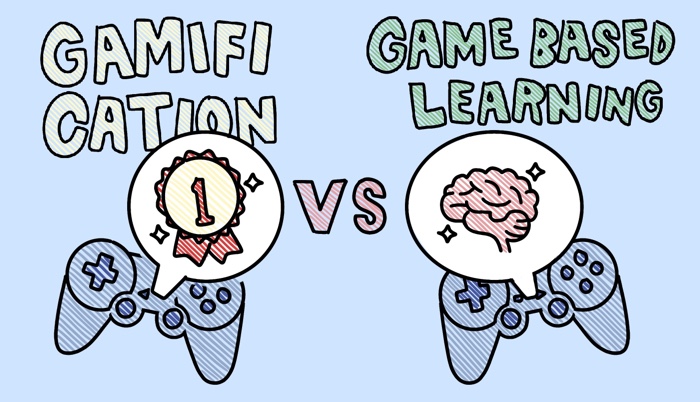
Game-based learning and gamification are in the same realm, namely gamified learning methodology. Therefore, the two terms are often used interchangeably. However, the two are actually two different things, both in terms of concept and in practice. If we do not clearly choose which concept we use when designing a lesson, we may encounter many problems in the future.
To understand the difference between game-based learning and gamification, we can compare the two on five critical factors; (1) their linkage to the learning process, (2) objectives, (3) participant involvement, (4) examples of application, and (5) weaknesses. After looking at these five factors, maybe we can decide which one is more suitable for our learning design.
Linkage to the learning process
Game-based learning uses game elements, from game mechanics, storylines, visual aesthetics, and technology. This is to teach certain learning materials to achieve predetermined learning goals. In game-based learning, all learning components such as learning objectives, structure, and core content of learning and evaluation of learning remain to be later developed in games. That way, the process becomes both fun and insightful for the participants. It means that in game-based learning, the learning process is the first to be designed. The game is integrated in such a way into the learning module that it becomes two inseparable things: the game is the learning.
Meanwhile, gamification only uses one game element, game mechanics, to be applied partially and is not directly related to the context of the game. The goal is to encourage the emergence of the expected behavior to improve learning outcomes. For example, training uses points, badges, leaderboards, and various other incentives. The game is used as a gimmick in gamification and becomes an "additional." The concept is simple, and the many ideas from mechanics that can be used make designing and using gamification in learning easier.
Objectives
Another feature that distinguishes game-based learning and gamification is their purpose. Some sources say that game-based learning aims to teach something specific. For example, we can deliver various leadership materials through visual novel games in leadership training. Participants in the game will meet an unknown character, who then shares stories about extraordinary leadership (this is actually a way to teach basic leadership theory). Then the participant will face problems related to leadership and use the understanding of the theory taught previously to solve these problems to advance to the next level. Therefore, to complete this game, participants must continue to learn actively and practice it throughout the game.
On the other hand, the goal of gamification is usually to increase engagement and gain focus and attention from participants. Various mechanics in gamification can increase participants' motivation to learn quickly (e.g., in-game scores, bonus points, etc.). Part of the mechanics is then used to "refresh" the participants during the learning session. In gamification, participants are actually involved in learning because they enjoy competing on the leaderboard. For example, when the teacher reviews the material being taught using a quiz with prizes, this is included in gamification. Some of the mechanics of gamification can also be applied in game-based learning design to raise participants' learning motivation.
Participant involvement
Game-based learning places participants as the main characters. This means that when participating in game-based learning, participants must participate fully and be in control of the course of their own learning process. Furthermore, game-based learning makes learners directly and deeply involved in making the learning process happen.
On the other hand, gamification can also increase the participants' involvement in learning sessions. However, the control of learning remains with the teacher. Participants follow directions and instructions from the teacher, who will use various gamification strategies (rewards, points, or rankings) to make participants want to be fully involved in the ongoing learning, for example, by rewarding participants who can complete tasks faster than others.
Examples of application
There are countless examples of game-based learning and gamification. Duolingo, the most popular language-learning app, is an example of how gamification can support adult learning. Features such as leaderboards, progress bars, and unlock badges can be found everywhere, supporting the main learning methods used to accelerate one's language comprehension: reading, speaking, listening, and writing.
Meanwhile, some more complex games such as iCivic (icivics.org) and Broken Coworkers (brokencoworker.com) are examples of game-based learning. Unfortunately, most game-based learning is tailor-made to meet the organization's needs and can only be accessed by its employees.
Weaknesses
Suppose we want to change the existing learning and development process, both at the individual and organizational levels. In that case, game-based learning offers many features that are worth considering. However, some drawbacks need to be addressed for thorough consideration. One of them is developing game-based learning takes more time and costs due to the complex design process. This can be overwhelming because most organizations have very fast-paced environments, and everything is expected to be agile. In this context, the organization hopes that everything must be handled quickly, which of course, applying game-based learning is not easy.
On the other hand, although gamification is easier to implement, it has several shortcomings. The biggest weakness of gamification lies in the learning design process. Since gamification does not involve game design in its instructional design, the approach is more appropriate to reach participants' extrinsic motivation. Hence, if the game's gimmicks are removed, it is likely that the participants will lose their desire to learn.
Conclusion
In conclusion, it is important to understand some things that can help us distinguish between game-based learning and gamification. Considering all factors mentioned above, it can be said that game-based learning is more fundamental than gamification with its gimmicks. However, which method is more suitable for our organization depends on our own organizational goals and how many resources, from budget, manpower, to time.
References
- Martin, M. (2020, September 17). Serious games, gamification and game-based learning: what's the difference? Grendel Games. https://grendelgames.com/serious-games-gamification-and-game-based-learning-whats-the-difference/
- Ingwersen, H. (2017, May 31). Gamification vs Games-Based Learning: What's the Difference? Capterra. https://blog.capterra.com/gamification-vs-games-based-learning/
- Eng, D. (2019, September 4). Game-Based Learning vs Gamification - Dave Eng. Medium. https://medium.com/@davengdesign/game-based-learning-vs-gamification-f44e5b09d808
- Findlay, J. (2016, July 12). Game-Based Learning vs. Gamification: Do You Know the Difference? Training Industry. https://trainingindustry.com/articles/learning-technologies/game-based-learning-vs-gamification-do-you-know-the-difference/
- University of Waterloo. (2018, March 1). Gamification and Game-Based Learning. Centre for Teaching Excellence. https://uwaterloo.ca/centre-for-teaching-excellence/teaching-resources/teaching-tips/educational-technologies/all/gamification-and-game-based-learning
- Mic, O. (2021, June 3). Show, don't tell: how gaming contributes to education and science. The Drum. https://www.thedrum.com/news/2021/06/03/show-dont-tell-how-gaming-contributes-education-and-scienc
Keep exploring: game-based courses · Play for Business · FAQ · General