5 Things You Need to Know about Game-Based Learning
By Play by FLIP Updated General
The gaming industry has experienced rapid growth since 2015. In 2015, there was a population of 42.8 million video game players with a market share of 321 million United States Dollars (USD). This figure rose to 1.1 billion USD or an increase of almost 350% (Newzoo, 2015, 2019; Statista, 2020). This growth is not only happening globally but also regionally and nationally. Developments in the gaming industry have placed Indonesia as the country with the largest video game market share in Southeast Asia and ranked 16th (sixteenth) in the world. Based on data compiled by Newzoo in 2020, Indonesia earned US$ 1.74 billion in revenue, and it will increase by 32.7% every year.
The increase in internet users and the rapid development of mobile devices are factors that determine the development of games in Indonesia. We also witnessed the rise of e-sport athletes. This resulted in almost 1/3 of people who play games, consider a professional career in the world of gaming. This indicates that games are not only for fun but playing games has also been taken more seriously by our society. Even so, many parties are still trying to make appropriate policies in their use and management (e.g. duration of time, or age limits, etc.).
In its 2021 report, Limelight Networks stated that people spend an average of 8 hours 27 minutes per day playing games. This is good news because the existence of games is actually very important in human life. In addition to personal interests (relieving stress, socialization, etc.), games are also starting to be used in the world of work (for selection, building engagement, etc.). For Play by FLIP, one of the most exciting applications of gaming is in the area of employee learning and development. The game-based learning (GBL) approach is known as one of the most attractive online learning solutions.
Here are 5 important things to know about game-based learning itself.
1. GBL is the new alternative for online learning
One of the factors that make the game-based learning approach revolutionary is its effectiveness in overcoming today's online learning challenges. Based on the focus group discussion (FGD) session with several HRD leaders, we found out that there was great enthusiasm for the idea of training using a game-based learning approach. Their responses to this approach can be categorized into three broad groups of insights.
The first is that game-based learning is expected to be very attractive to participants (employees). The nature of the game is fun and uplifting. The interactive game format is believed will be able to attract and retain the attention of participants because of the immersive learning experience. The company sees this as a good breakthrough because designing attractive training sessions is not an easy thing to do.
The second relates to how the game-based learning approach enables seamless learning. The broad range of creative options in the game-based learning design process allow us to teach various types of training modules such as technical skills development or non-technical courses. The method can also be an independent online learning or part of a hybrid learning program. In addition, everyone can use game-based learning in a corporate settings regardless of their job position, function, and task. This was good news for almost all of the FGD participants because they had difficulties making different training sessions for various competencies at different levels and types of work.
Finally, all FGD participants believed that game-based learning could increase the effectiveness of learning. Humans can learn something new faster and better by playing games. The technological features that accompany game-based learning make this possible. For example, there is the convenience of doing repetition. We all know how important repetition is in the learning process (which is difficult to do in traditional learning duee time limitation). In addition, in game-based learning, participants can also get immediate feedback on their learning progress.
1. GBL is a learning tool
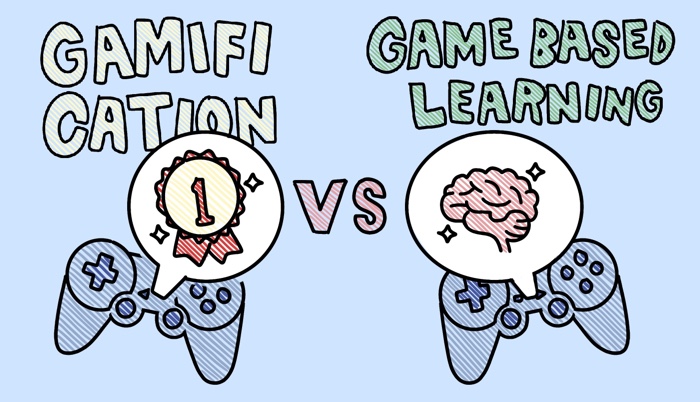
The underlying idea of the learning by playing concept, which became known as the game-based learning approach, was first introduced by Friedrich Fröbel in the late 1970s. Game-based learning uses the principles of games in learning activities to improve the learning experience and the accomplishment of learning objectives.
Game-based learning uses the main principles of the game such as missions to be achieved, competition,adventures to go through, fictional characters, etc. Participants can also learn through a number of failures, repetitions, as well as a dynamic process in achieving a mission, where they are also the main actors.
However, please be noted that because this is still a learning tool, games must be designed by prioritizing learning principles (such as having clear learning objectives, structured instructional models, and measuring specific learning effectiveness). In contrast to games that are entertainment in nature, in game-based learning, learning is the main thing. Briefly, in this approach, there must be 3 things need to be considered: learning, measurement, and high engagement.
In game-based learning, participants start learning slowly. Their abilities are honed as the game progresses, especially as they progress to more difficult levels. Therefore, good game-based learning is one that facilitates learning with a moderate level of difficulty, in the sense that it is difficult enough to make the participants feel challenged, but at the same time it is quite easy, so they are not discouraged to continue learning while playing. In addition, good game-based learning should also be able to increase motivation to learn by making participants feel that facing difficulties and overcoming challenges can also provide fun.
2. GBL is designed comprehensively
Technically, creating game-based learning begins with designing the learning first, then followed by various aspects of the game. Learning design in GBL follows the principles of learning design in other teaching methods. It usually begins by determine learning objectives and then followed by structured segments and sub-segments to ensure participants get the material and practice opportunities they need. If the learning design has been completed, then the next process is to design the game itself.
While the learning design is supported by experts in curriculum design, various learning methods, etc, the game design team consists of a number of experts with their respective fields such as story writers, game architects, visual artists, code designers (programmers), music designers and so on. This unique collaboration between the two teams of experts will result in a game that is not only fun to play, but also capable of providing meaningful learning.
3. GBL influence our brain
Have you ever wondered what makes us want to keep playing games? Research shows that our brain releases lots of happy hormones like endorphins, dopamine, and serotonin when we play games. Endorphins appear when we succeed in achieving something, while the other three hormones are the reason behind the pleasure, appetite, and good mood we have. Many studies also explain that these three hormones can increase our learning capacity, creativity, and focus.
And yes, we can get both at once when we learn by using a game-based learning approach. Physiologically it will produce a number of hormones that can help the learning process, and psychologically we will get a sense of pleasure and happiness.
4. GBL is relevant to participants in the modern world
Since game-based learning basically utilizes fictional stories, we have the creative freedom to create stories and contexts (including the imaginative world) that are relevant to the participants to ensure better absorption of learning material. Moreover, this approach allows us to build contexts and stories that are relevant to the culture or everyday life experienced by the participants. For example, in Indonesia, we can use traditional folklore or social life as a background story to increase participant engagement because they feel the relevance of the game to their daily lives. This is alligned with a number of studies that stated that learning activities are not culture/context-free.
If you want to use a game-based learning approach for your organization, try PLAY's newest online game-based training.
Reference
- Limelight Networks. (2021, March 9). State of Online Gaming 2021 Landing Page. Limelight Networks Inc. https://www.limelight.com/lp/state-of-online-gaming-2021/
- Sheth, H. (2021, March 15). Time spent on video games up 14% in 2020: Report. @businessline. https://www.thehindubusinessline.com/news/national/time-spent-on-video-games-up-14-in-2020-report/article34072678.ece
- Combs, V. (2021, March 10). 8 hours and 27 minutes. That's how long the average gamer plays each week. TechRepublic. https://www.techrepublic.com/article/8-hours-and-27-minutes-thats-how-long-the-average-gamer-plays-each-week/
- Denton, M. (2021, May 3). The science behind game-based learning. Gamify. https://www.gamify.com/gamification-blog/the-science-behind-game-based-learning
- Hamre, E. (2021, January 15). How to Maximise Your Productivity By Turning Your Life Into a Game. Medium. https://medium.com/skilluped/how-to-maximise-your-productivity-by-turning-your-life-into-a-game-511486a8afd8
- Cahill, G. (n.d.). Why Game-Based Learning? The Learning Counsel. Retrieved September 3, 2021, from https://thelearningcounsel.com/article/why-game-based-learning
In this guide
Keep exploring: game-based courses · Play for Business · FAQ · General